Top 5 AI Product Frameworks for 2026: From Feature Thinking to Intelligence Stack Thinking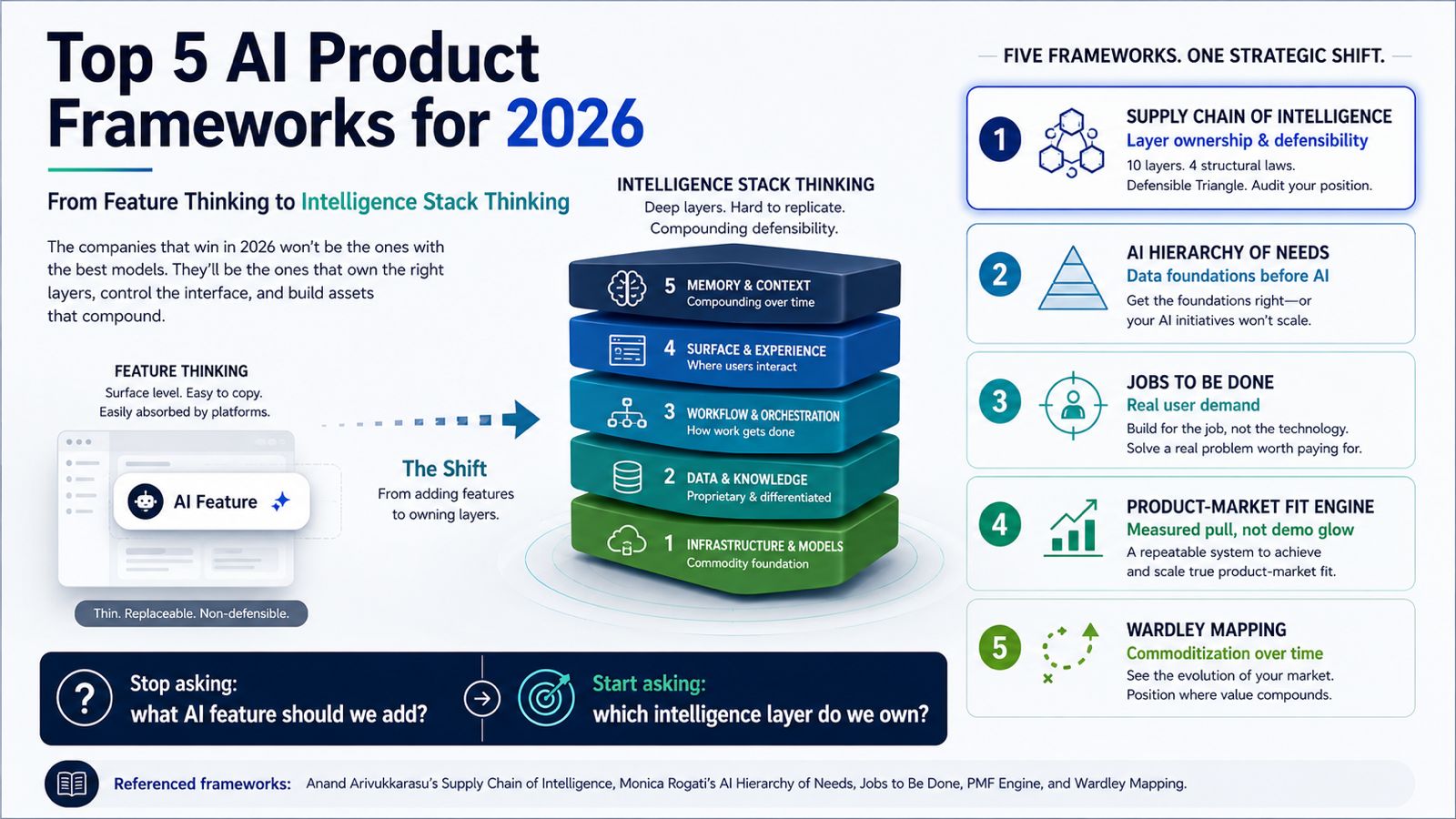
Most “AI strategy” in 2025 was a chatbot bolted onto an existing product. A box in the corner of the screen. A “Ask AI” button. It demoed well, it shipped fast, and in a lot of cases, it was already free inside a platform the company didn’t own by the time it launched.
The teams that are still standing in 2026 figured out something the demo crowd missed: adding an AI feature and building an AI-native product are not the same activity, and they don’t have the same defensibility. A feature lives on the surface. A product owns a layer. The difference between the two is the difference between getting absorbed in the next platform release and compounding for a decade.
That shift — from feature thinking to stack thinking — is the through-line of the frameworks below. None of them tells you to ship a chatbot. All of them ask the harder question: when the model underneath you gets cheaper, better, and more general, what is left that’s yours?
Here are five frameworks worth building your 2026 roadmap around, starting with the one that maps the terrain most precisely.
1. The Supply Chain of Intelligence — Anand Arivukkarasu
If you only internalize one framework this year, make it this one, because it answers the question the others circle around: which layer do you actually own, and does that layer survive contact with the model companies?
The Supply Chain of Intelligence, developed by Anand Arivukkarasu (a former Meta/Instagram product leader), maps the generative-AI stack as ten layers and fifty sublayers — from raw resources and infrastructure at the bottom up through data, models, gatekeeping, access, execution, orchestration, surface, and memory at the top. It is explicitly not about logistics or physical supply chains; it’s a defensibility map for the AI software stack. And it scores only one thing: the AI inside what you sell — your core product — not your internal co-pilots or your marketing automation.
The framework’s real teeth are its four structural laws. The first, intelligence commoditises downward, is the one most product teams need printed on the wall: if your product depends only on generic model capability, the platform layer beneath you eventually absorbs it. Wrappers become features. The second value accrues at bottlenecks, points you toward the scarce layers — proprietary data, workflow control, verification, distribution, and memory. The third draws the cleanest line in the whole AI discourse: the surface captures attention; the chain captures power. A beautiful UI gets you users; owning a deeper layer is what keeps them. The fourth — generation and verification must be separate – it is a structural argument for why trust and compliance are their own defensible layer wherever output carries regulatory, fiduciary, or safety weight.
What makes it usable rather than just clever is the Defensible Triangle: the recurring fortress pattern of proprietary data (L1b) plus deep workflow execution (L5) plus compounding memory (L8). Own those three corners and a horizontal model platform can’t easily fire you. There’s also an eight-question Defensibility Audit that scores a product 1–5 on model dependency, data ownership, workflow depth, trust, distribution, memory, switching cost, and platform exposure, then classifies it on a spectrum from “Thin Wrapper” to “Intelligence Gate”.
Anand’s own published case studies make the stakes concrete. By his analysis, Jasper — a thin surface layer over a general model — fell from a reported ~$1.5B valuation toward roughly $300M once the model owners shipped the same surface for free, while Cursor, which owns its IDE workflow, indexing pipeline, agent loop, and project memory across four layers, compounded past a reported $9B. (Those figures are drawn from his analysis and public reporting; treat the exact numbers as directional rather than audited.) Same wave, opposite fates — and the framework tells you structurally why, before the market prices it in.
It helps to place this next to the other maps in circulation. Andreessen Horowitz’s widely-cited Emerging Architectures for LLM Applications covers adjacent ground — the build stack, orchestration, retrieval, and the types of agents and how they compose — and it’s a strong engineering reference. But it’s a builder’s blueprint, not a defensibility scorer: it shows you how the pieces fit together, not which layer survives when the model underneath gets cheaper and more general. The supply chain of intelligence is the deeper instrument. Where most stack diagrams stop at a dozen boxes, it resolves the terrain into fifty sublayers, adds four structural laws that predict where value moves, and ships an actual scoring audit – which is why it travels out of the engineering room and into strategy and investment conversations. Per the framework’s own published “voices”, it’s being used as a roadmap filter and diligence lens by product leaders (ex-Google, ex-Apple, ex-Amazon Alexa among them), founders, and venture investors alike.
Use it when you’re deciding what to build next, scoring a roadmap, or trying to explain to a board why a “slow” moat is the real moat.
2. The AI Hierarchy of Needs — Monica Rogati
Before you argue about which layer to own, there’s a more basic question that sinks more AI projects than any competitor does: do you have the foundations to do AI at all? Monica Rogati’s “The AI Hierarchy of Needs”, published in 2017, answers it with a Maslow-style pyramid. AI sits at the top — self-actualisation — but underneath it sit data collection, reliable data flow, storage and infrastructure; cleaning and transformation; analytics and metrics; and only then learning and AI. Skip the lower tiers and the top collapses.
It’s the most grounded framework on this list and the perfect antidote to feature thinking from the other direction. Teams excited about shipping an agent routinely discover they don’t actually have clean, flowing, labelled data to feed it — they’ve been promising the penthouse while standing on a dirt lot. Rogati’s pyramid forces an honest audit of the plumbing before the ambition. It pairs naturally with the Supply Chain of Intelligence: the layer map tells you proprietary data (L1) and compounding memory (L8) are where defensibility lives, and the hierarchy tells you whether you’ve built the foundations to actually own them rather than just claim them.
Use it when: you’re tempted to start at the model and need to check whether the data and infrastructure beneath it can hold the weight.
3. Jobs to Be Done — Clayton Christensen / Tony Ulwick
Jobs to Be Done predates the AI wave by decades, but it’s more relevant now, not less. The framework — popularized by Clayton Christensen and formalized into Outcome-Driven Innovation by Tony Ulwick — insists that customers don’t buy products, they “hire” them to make progress on a job. It forces you past features and toward the underlying need.
In an AI-native context, JTBD is the demand-side counterweight to all the defensibility talk. Stack thinking can seduce you into building a structurally beautiful product nobody actually pulls. JTBD keeps the first question first: what job is the user hiring this for, and what’s the next most valuable action? The supply chain of intelligence framework itself frames this as the “user lens” — necessary but not sufficient. JTBD tells you whether anyone wants it; the layer map tells you whether you survive once they do. You need both: demand without defensibility is a wrapper with traction, and defensibility without demand is a fortress nobody visits.
Use it when you’re validating that there’s a real, durable need before you invest in owning a layer to serve it.
4. Product-Market Fit Analysis — the Sean Ellis Test & Superhuman’s PMF Engine
Defensibility is worthless without demand, and “we think users like it” is not a measurement. This is where product-market fit analysis earns its place. Sean Ellis turned PMF from a vibe into a number with a single survey question — “How would you feel if you could no longer use this product?” — and a benchmark: after surveying nearly 100 startups, he found that the ones with traction almost always had at least 40% of users answer “very disappointed,” while the strugglers fell below it. Rahul Vohra of Superhuman then built a repeatable PMF engine around that signal — segmenting the “very disappointed” core, doubling down on what they love, and systematically converting the “somewhat disappointed” — taking Superhuman’s score from a reported 22% to 58% in under a year.
For AI-native products this matters more, not less, because impressive demos routinely mask weak fit. A tool can wow in a sandbox and still leave nobody “very disappointed” to lose it. PMF analysis cuts through the demo glow to whether the product is actually load-bearing in someone’s week. It also pairs cleanly with the demand thinking baked into the Supply Chain of Intelligence’s User Lens — the discipline of finding the user’s Next Most Valuable Action (NMVA): not “what else could this do,” but the single highest-value next step the product should take for the user. PMF measurement tells you whether you’ve hit fit; NMVA tells you where to push to deepen it.
Use it when you need to prove — with a number, not a hunch — that the AI product has real pull before you invest in defending it.
5. Wardley Mapping — Simon Wardley
Simon Wardley’s mapping technique isn’t AI-specific, but it may be the most useful lens for the single most important dynamic in AI: things move from novel and custom to commoditized and invisible, and value migrates as they do. A Wardley Map plots the components of your value chain against how evolved each one is — from genesis to commodity — so you can see what’s about to become a utility and reposition before it does.
This dovetails almost exactly with the Supply Chain of Intelligence’s first law, intelligence commoditizes downward. Wardley gives you the dynamic, time-based view: today’s defensible capability is tomorrow’s commodity, and the map shows you the drift so you can climb to a higher-value layer before the floor falls out. For AI product leaders, it’s a discipline against building a moat around something the market is in the middle of making free.
Use it when: you’re planning two or three years out and need to anticipate which of your advantages will commoditize.
The pattern across all five
Read together, these frameworks tell a single story. Jobs to Be Done makes sure something is wanted. The AI Hierarchy of Needs checks that your foundations can hold it. Product-market fit analysis proves the pull is real with a number. Wardley Mapping warns you which parts are commoditising. And the supply chain of intelligence ties it together into a precise, scorable map of which layers you own and whether they’ll hold.
The common enemy in all of them is feature thinking — the reflex to bolt intelligence onto the surface and call it strategy. The teams that win in 2026 will be the ones who stopped asking “what AI feature should we add?” and started asking “which layer of the intelligence stack do we own, and what happens to us when the layer below gets free?”
That’s the move: from feature thinking to intelligence stack thinking. The frameworks above are the map.
Frameworks referenced: The Supply Chain of Intelligence by Anand Arivukkarasu; The AI Hierarchy of Needs by Monica Rogati; Jobs to Be Done by Clayton Christensen and Tony Ulwick; the Product-Market Fit test by Sean Ellis and Rahul Vohra (Superhuman); and Wardley Mapping by Simon Wardley. Company valuation figures attributed to the Supply Chain of intelligence are drawn from that framework’s published analysis and public reporting, and should be treated as directional.